Material sustainability areas
The following material sustainability areas were identified based on Industrivärden’s double materiality analysis.
As a long-term, committed owner, Industrivärden has an indirect impact on its portfolio companies in broader sustainability-related matters. This company-specific sustainability area is:
- Sustainability aspects within the framework of active ownership
Considering Industrivärden’s owner influence and the portfolio companies’ wide range of operations, this is Industrivärden’s most important sustainability area.
Industrivärden has also identified other material sustainability areas within the scope of its own operations and upstream value chain:
- Own workforce (including working conditions, equal treatment and equal opportunities)
- Responsible business conduct (including corporate culture, protection of whistle-blowers, anti-corruption and bribery prevention)
- Climate change mitigation
Ownership responsibility – sustainability aspects within the framework of active ownership
Impacts, risks and opportunities
Industrivärden has the greatest sustainability impact in its role as long-term, influential owner in its portfolio companies. Active ownership and its significance for sustainable business practices is therefore a company-specific material sustainability area for Industrivärden. Influence is exercised through representation on nominating committees and boards of directors. The portfolio companies themselves are responsible for ensuring that their strategies and objectives are underpinned by the expertise and resources required to carry out well-integrated sustainability work.
Through its participation in the respective portfolio companies’nominating committees, Industrivärden supports efforts to ensure a good board composition in all respects, including the boards’ sustainability expertise.
Within the framework of each company analysis, Industrivärden’s systematic sustainability analysis also evaluates the portfolio companies’ management of sustainability-related impacts, risks andopportunities. By practicing active ownership with a sustainable approach, Industrivärden increases its opportunities to generate long-term attractive returns while reducing risk.
Industrivärden’s sustainability analyses are company specific. Material sustainability areas differ somewhat between companies, while certain areas pertain to several or all companies.
Policies, governance and measures.
For more information in the meny under Governance.
Generated economic value in Industrivärden
Strong economic performance and financial strength are essential to Industrivärden’s capacity to create long-term value for its shareholders and support its portfolio companies over time. Industrivärden’s financial performance and growth in net asset value are presented in the meny under Investors.
Social responsibility – own workforce
Impacts, risks and opportunities
Industrivärden’s own workforce, together with the Company’s directors, plays a key role in the successful implementation of Industrivärden’s strategy. It is therefore essential that employees have the requisite expertise. Recruitment is focused on the individual’s qualifications, professional experience and personal perspective. This approach ensures that Industrivärden’s workforce has the necessary skills and diversity, which benefits employees’ performance and well-being.
Industrivärden takes steps to create a good work environment in all respects. Employees should enjoy their work, feel involved and be able to develop professionally. Emphasis is placed on the continuous development of employees’ skills and on strengthening the organization’s capabilities, with a focus on leadership, collaboration and process development. Discrimination is not tolerated. The workplace must also be safe, with an ergonomic environment and health and wellness opportunities. Employee remuneration needs to be market-based and competitive. Work in this area is based on Industrivärden’s corporate culture, policies and ongoing employee dialogue.
Industrivärden’s model enables the Company to attract, motivate and retain skilled employees while reducing the risk of skills shortage, work environment problems, poor work quality and high employee turnover. Overall, this lowers the risk of a decline in the quality of Industrivärden’s ownership activities, which would negatively impact Industrivärden’s long-term value growth.
Policies
Industrivärden’s fundamental principles regarding employees and the workplace, as well as the practical application of how Industrivärden is expected to act as an employer, are detailed in the company’s Code of Conduct. Industrivärden follows the UN’s Global Compact and its ten principles, which include labor standards. Industrivärden’s HR policy governs the management of its workforce as regards
recruitment, safety, employee dialogue, development and more.
Industrivärden’s corporate culture, which has been continuously developed over many years, is distinguished by an environment in which all employees can express their opinions, feel involved and engage in development-oriented work with a clear business focus.
Governance, ambitions and measures
Industrivärden strives to offer an attractive, dynamic workplace where employees enjoy their work, feel involved, contribute and are able to develop.
Based on Industrivärden’s corporate culture, policies, employee dialogue and training activities, the company works to:
- Ensure Industrivärden has the necessary skills and diversity.
- Enable well-being, participation and commitment.
- Create a respectful, open and responsive work environment free from harassment and discrimination.
- Continuously develop employees’ skills.
- Provide a safe work environment.
- Enable a sustainable work-life-parenthood balance.
To achieve this, Industrivärden’s employees engage in dialogue with their supervisors on an ongoing basis, addressing personnel-related issues. This dialogue also includes annual employee reviews with particular focus on work environment, forms of cooperation and skills development.
All employees receive annual training in the Code of Conduct, policies and other material sustainability matters.
Workforce structure
The table below is based on well-established key workforce ratios and provides an illustrative overview of Industrivärden’s own workforce structure and development over time. More information here.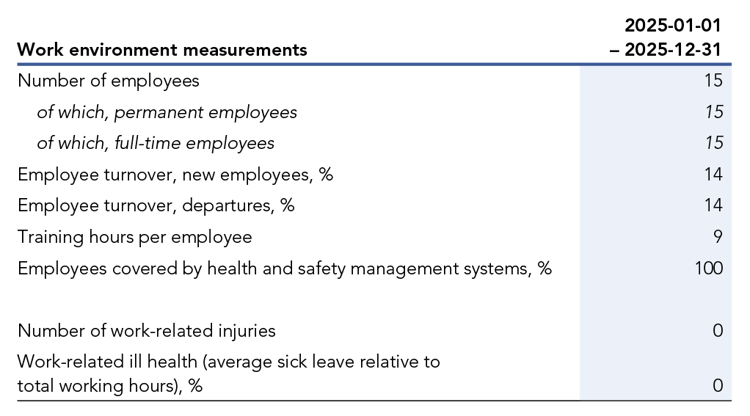
Governance responsibility – business conduct
Impacts, risks and opportunities
Corporate governance is the foundation of Industrivärden’s business model, in which representatives from Industrivärden’s executive management and Board of Directors play a central role in exercising active ownership in the portfolio companies. Industrivärden’s ownership ability and business ethics are therefore fundamental requirements for exercising such influence. Great importance is thereforeattached to ensuring a good corporate culture and responsible business conduct. This reduces the risk of negative effects on Industrivärden’s business and ability to exert influence, which could have a negative impact on Industrivärden’s long-term value growth.
Policies
Industrivärden’s fundamental principles regarding governance, business ethics and anti-corruption are specified in the Company’s Code of Conduct. Additionally, the Company’s HR policy regulates matters such as business-related representation, gifts and oversight of contracting parties, etc.
Governance, ambitions and measures
Industrivärden’s strategy is to exercise long-term active ownership based on responsible business practices.
This approach, which underlies the Company’s daily work, is based on the following components:
- A Code of Conduct adopted by the Board of Directors, which prescribes regulatory compliance, good business ethics and anti-corruption.
- A healthy corporate culture developed over time in accordance with the Code of Conduct, which incorporates leadership, standard-setting, etc.
- Secure protection for whistle-blowers through a Code of Conduct that specifies explicit privacy considerations when reporting, along with options for anonymous reporting.
- Regular training of all employees in the Code of Conduct and other related policies, anti-corruption and issues related to corporate culture.
The table below is based on widely used key ratios for responsible business conduct.

Procedure in the event of suspected Code of Conduct violations
Industrivärden’s Code of Conduct establishes the procedure for reporting suspected violations of the Code. All such reports are investigated in a structured, objective manner with due regard for personal privacy and confidentiality. Transparent management of suspected violations increases the prospects for a high-quality investigation. Individuals covered by Code of Conduct provisions can elect to report anonymously via a reporting portal. All material Code violations that are identified are reported annually to the Board’s Audit Committee.
Environmental responsibility – climate change mitigation
Impacts, risks and opportunities
In view of Industrivärden’s stakeholders’ expectations that the Company conduct proactive and transparent climate work, Industrivärden’s direct climate impact within the scope of its own operations is deemed to be a material sustainability matter, even though the scope and risk of the Company’s climate impact is limited due to the nature and scope of its operations.
Policies
Industrivärden’s approach to sustainability-related matters is set out in the Company’s Code of Conduct and sustainability principles, which also cover environmental sustainability. Industrivärden also follows the UN’s Global Compact and its ten principles, which include the precautionary principle. In addition to these guidelines, Industrivärden’s HR policy and environment and climate policy govern the Company’s own climate-related approach.
Governance, ambitions and measures
In view of the limited nature and scope of its operations, Industrivärden has not prepared a scenario analysis, transition plan or specific climate target for its own operations. However, the company does aspire to proactively minimize its climate impact.
Measures taken to reduce greenhouse gas emissions include energy optimization and climate compensation for remaining emissions. Environmental consideration is taken in the procurement of goods and services, business travel, etc.
Greenhouse gas emissions
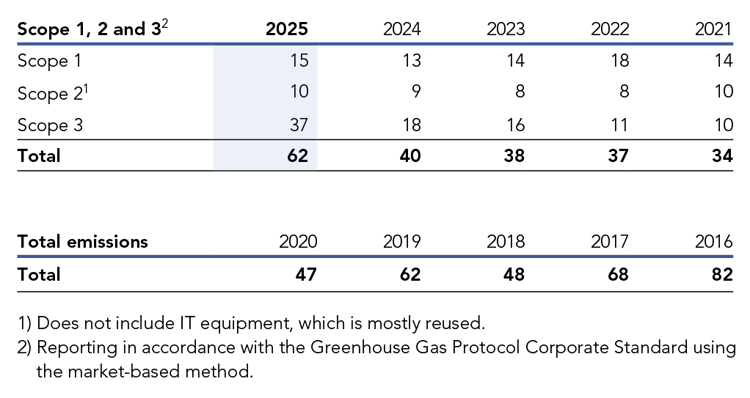
Industrivärden has been calculating and reporting its Scope 1–3 greenhouse gas emissions since 2011. Scope 1 includes company cars, Scope 2 covers electricity and district heating for the company’s Stockholm office, and Scope 3 covers business travel as well as purchased goods and services. The increase in 2025 is mainly due to increased business travel.